
 Mt. Hood is Oregon's defining landmark and the place I first took an interest in climbing. After living in Portland for seven years, I still can't go outside on a clear day without pausing when I see it. In May 2008, I joined three friends and a guide for an ascent on the standard south route up the Hogsback. And every year since I've been back - twice up the southern route, once up Leuthold's Couloir and, on Thursday, June 30, 2011, up the Wy'east route - each time with my friend Jared and guide Geoff from Timberline Mountain Guides.
The key to climbing Hood is getting an early start - early like when the bars close. I picked up Jared in Portland on June 29th at 10:30 p.m. and we cruised up to the mountain through Gresham and Sandy without traffic. When we arrived at the parking lot at Timberline Lodge, conditions were terrible - spurts of rain were coming down and the wind was blowing. According to the weather app on my iPhone, the only green blob on the Doppler radar found anywhere in the Portland area was lingering on Hood. We took a quick nap (maybe 20 minutes) in the car before meeting Geoff at 1:15 a.m.
Our snowcat departed at 2:00 a.m. and drove us to the top of the skiing area. Normally the glowing lights of Oregon City, Madras and other familiar places are seen out the windows of the tracked vehicle. But this time, blackness ominously prevailed. We exited the snowcat into brutal conditions - the wind howled and gusted, pelting us with a stinging rain. Fortunately Geoff had us put on our waterproof Gortex gear before leaving the lodge. My climbing experience is relatively limited, but it's safe to say the climbing conditions were the worst I'd ever seen. Typically I try to hold out for clear weather - or turn back. Within minutes, ice started to coat our backpacks, helmets and jackets.
We immediately clicked on our headlamps, put on crampons and armed ourselves with an ice axe in one hand, trekking pole in the other. The Wy'east route took us to the northeast of the skiing area on a steady incline. Geoff soon had us rope together as we crossed a crevasse field. The crevasses on Hood are smaller and less numerous than on Rainier, Baker and some of the other volcanoes in the Cascades. But the danger is still one to take seriously. More than forty or fifty feet of rope separated each of us. Geoff led with Jared in the middle and me in the rear. As we climbed, I could barely make out Jared's headlamp - and I couldn't see Geoff at all. Only when he paused and cut back towards me to find a safe route through the crevasse field could I make out the dim light of his helmet.
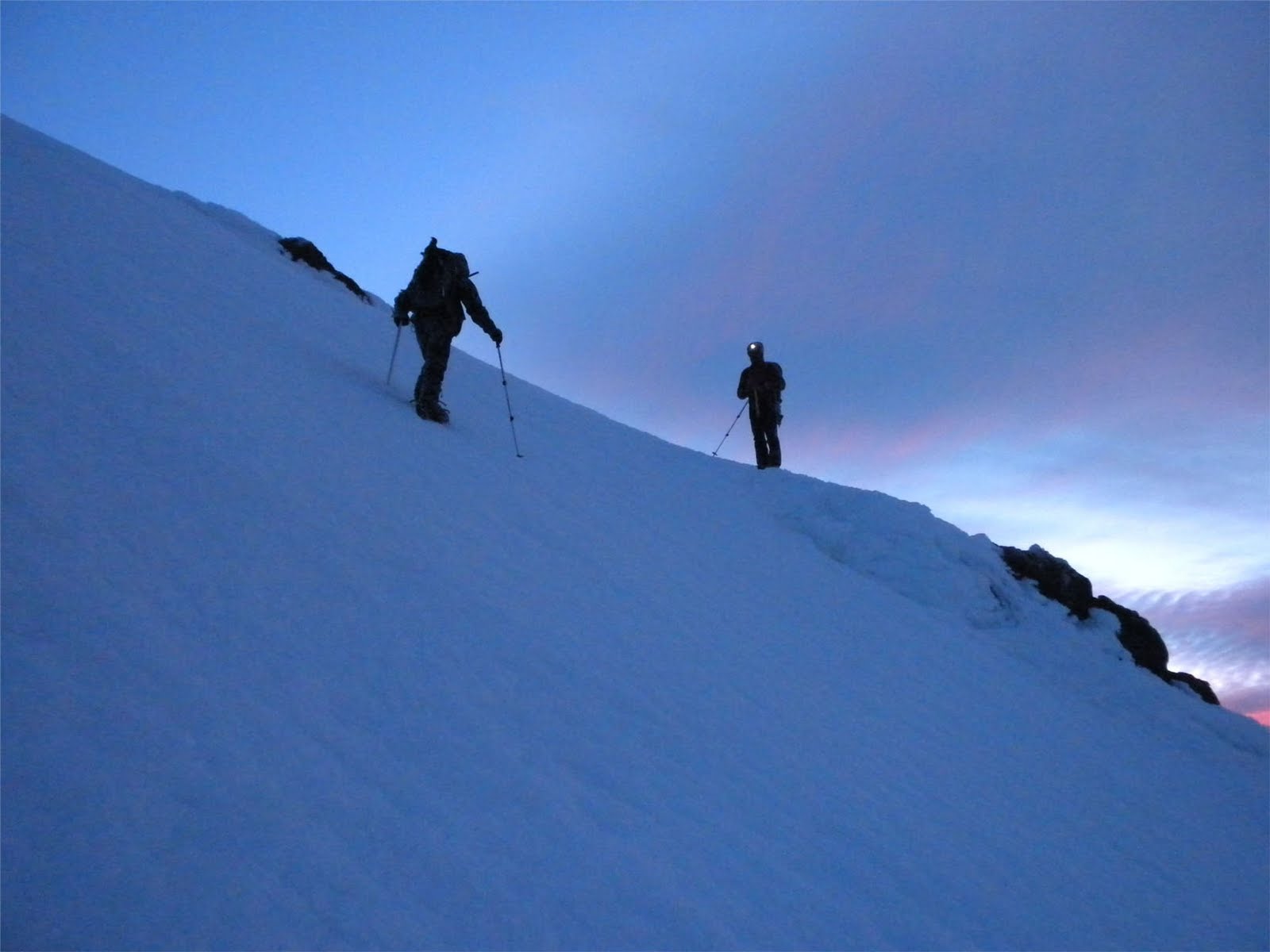
The wind continued to hit us hard, occasionally knocking me around. I took care with each step to ensure my axe and pole were securely placed to provide stability from the wind. In several places I could see the edge of what looked to be a significant drop, but a blanket of darkness left me in blissful ignorance of the exposure. Geoff directed us to carefully follow in his footsteps to reduce the danger of falling. I definitely felt outside of my comfort zone a few times, and I think Jared did as well. But that's why it's important to climb with a guide, especially one as good as Geoff. Having a guide is partly for the additional safety, but also for the push - you'll never grow as a climber (or, for that matter, as a person) if you stay within your safety zone.

Above the crevasse area, we continued moving upward diagonally and eventually crossed over to the east side of the mountain. The sun had yet to rise, but a hint of the forthcoming light started to appear on the horizon. The snow turned from an icy crust to what I'll call hard wind-blown icy, making it difficult to gain purchase with my crampons as the steepness of the slope increased. We pushed onward without stopping until we reached the first rocky patch of the climb. Ice continued to coat our bodies and our gear with a frozen shell. I had to break the ice off my straps just to remove the clasps on my backpack. Above this point, the slope lessened and Geoff took us off the rope as we continued our diagonal upward progress on Hood's eastern flank. Soon the first rays of the sun appeared on the horizon, magnificently illuminating the snow, and we finally emerged from the cloudbank that had enveloped us since the parking lot. I paused a hundred feet back from Jared and Geoff to capture pictures of the scene. I didn't want my mind's eye to be my only means of remembrance - there's nothing quite like sunrise on a mountain after you've been climbing through the night.

By the time I caught up with them, we had a serious talk about whether or not to continue forward. The wind continued to blow and push us around. During a rest break, Geoff's open pack was knocked over and he had to dive on it to ensure critical pieces of equipment didn't slide down the mountain out of reach. We all had our doubts about continuing - especially because of the path ahead. The upper reaches of the Wy'east route include climbing along a windy, exposed ridgeline. But Geoff remained optimistic based on the forecast that the wind would lessen, and we unanimously decided to continue. Here's a clip from our rest stop:

Geoff had us rope up again - this time much closer together - and we started climbing up a slightly steeper slope. The pitch continued to increase and I felt glad we were tethered to each other. I also started feeling the impact of altitude and lack of sleep. But despite the cold and the wind, I couldn't think of a place at that moment I'd rather be. Below us, the high peaks of the Oregon Cascades poked up above a thick layer of clouds - a few alpine islands surrounded by a foggy white sea. I could also see the curved meander of the Columbia River at the Dalles.

Eventually we reached the top of a ridgeline and caught a glimpse to the west into the crater and climbers ascending the Old Chute - the route I had climbed twice before and the path our descent would take us later in the morning on the way down from the summit. We followed the ridgeline upward for awhile and halted at a more difficult stretch that required us to climb several pitches on belay to continue. At this point we were near the summit, but still had to complete the most difficult climbing of the entire route. Jared and I both learned basic belay technique several years prior as part of a one-day training taught by Geoff. But we had never belayed in action. Here's footage looking into the crater:

Geoff instructed us to stay put and he climbed up one full rope length and set an ice anchor to support the belay. He then sent his two ice tools down the rope so we'd each have the benefit of dual axes. Jared stepped up the slope first with me close behind on the rope, only a few feet separating his crampons from my face. We took things slow, using both ice tools and front-pointing our crampons. I'm not going to lie - I was nervous as hell. But a step at a time, and with encouragement from Geoff - we made it up the first pitch. With the sun fully up, fatigue increasing by the minute and the whole of north-central Oregon to our backs, the word surreal came to mind more than once. Here's a clip of us preparing to go on belay:
Here's footage of Geoff climbing up the route before setting the first ice anchor:
Geoff left us securely fastened to the rope and the ice anchor and climbed up the second pitch. This one seemed easier than the first, but in some ways proved more difficult. Geoff opted not to send the two additional ice tools down the rope this time. Once he had climbed up the second pitch, Geoff yelled down to us to proceed. Following Geoff's instructions, Jared pulled out the first anchor and handed it to me to clip to my harness. Swinging our axes like hammers and stepping with the front-points of our crampons, we cautiously advanced upward on belay. Jared and I both hit places where we felt extremely uncomfortable. Speaking for myself, I shattered my previous comfort zone to pieces. But on the positive side, the wind that had hounded us since Timberline gave us a much-needed respite. With calves screaming from the physical strain of front-pointing, we both finally caught up to Geoff and the second anchor point. Here's footage of Geoff climbing up the second pitch:
Here's Jared and I preparing to go on the second belay:
This clip shows the struggle:

And then things got dicier. Geoff climbed up ahead with about 3/4 of a length of rope - not quite a full pitch. Although the slope was steep - perhaps 50-55 degrees - Geoff created a boot path for us to follow on belay and once again sent his ice tools down the rope. But by now the sun was warming the snow and melting the icy crust. A helmet-shaped chunk of ice fell from Jared's head and hit me in the face. As we went up, I struggled and struggled to make progress. I inadvertently made a five foot long platform by stepping back in forth in vain trying to make upward progress. With advice from Jared and Geoff on how to put pressure on my ice tools rather than my feet, I was able to lift myself up enough to break through the crappy snow. First Jared, then myself, we reached the top of the ridgeline and the end of the belays.
Here's video from this stretch - the helmet camera fogged up a bit:
And more footage of Jared and I finishing the last belay and reaching the ridgeline below the summit:
While on belay, we had started to heat up from the sun's rays and absence of wind. But once we reached Geoff on the top ridgeline, we were buffeted by the cold wind. Poor Geoff had waited in the cold - unable to move to stay warm - as he belayed our agonizingly slow progress up the slope. I greatly appreciated his patience because it took us a long time to finish the belays.

Above this point was the home stretch. After a quick jaunt up the ridgeline, we reached the summit around 10:30 a.m. For Jared and I, it was our fourth time standing on Hood's most hallowed ground. For Geoff, it was his 170th+ Hood summit. The wind was still blowing hard, but seeing the best of Cascadia - including Adams and Rainier to the north - took the edge off. We also had the place entirely to ourselves - something I hadn't experienced before. The climbers going up the south route had already summited and turned for home. Being able to spend alone time on a clear day on the second most-climbed mountain in the world after Mt. Fuji is a rare treat.
Here's a clip of us taking the final steps towards the summit:

We found a spot sheltered from the wind to rest, eat and take pictures. I brought out my Portland Timbers soccer scarf and indulged my excessive fandom. As we rested and refueled, Geoff shared some molasses cookies from Trader Joe's. In climbing, I've learned the importance of the right food at the right time - it can be a tube of Pringles after hiking all day to high camp, a well-timed Cliff bar for energy or a bag of salmon jerky when nothing else sounds good. On this climb, Geoff's cookie fit the bill. For whatever reason, it tasted a hundred times better than my other snackables and gave me the boost I needed before heading home.

Eventually the cold from being stationary became unbearable and we packed up to begin our descent. At the top of the Old Chute, Geoff had us rope up and put us on belay for one pitch. The snow was still firm enough for climbing down safely, but one misstep could easily result in an out-of-control fall down the icy chute. I led the way with Jared close behind. Our initial pace was cautiously slow to avoid slipping and falling. But our speed increased as the grade of the slope lessened. Small pieces of ice - melted by the sun - fell from above and rolled to the bottom of the crater. Most of them were harmless, but Geoff pushed us downward before resting to get out of the shooting gallery in case something more dangerous decided to make an appearance.

We soon reached the bottom of the crater, unclipped from the rope and hiked over to the base of the Hogsback for a rest break. It was nice to take off our climbing harness and layer down - the temperature was starting to heat up. I found it odd to be sitting in the crater with no other climbers. On my previous climbs, at least a dozen or more others were present. Two years prior we had nearly witnessed a heinous fall that resulted in a climber getting a ride in a Blackhawk helicopter to receive medical attention. We saw the aftermath just minutes after the accident had occurred. But on this day, it was just the three of us. I stared for awhile at the bergschrund - a crevasse formed when glacier ice separates from the ice above at the upper end of a glacier - at the top of the Hogsback. It seemed much larger than I remembered it from previous seasons, possibly a result of the year's above-average snowpack.

Layered-down, sun-screened and ready for beer, we proceeded without delay for Timberline Lodge. The firm ice of the Wy'east route seemed a distant memory as we post-holed our way down from the crater. The sun had warmed the snow enough to weaken the integrity of the icy crust, resulting in a textbook "slog" down the mountain. Many - perhaps all - of George Carlin's seven words were thought or uttered aloud on the descent. I had a miserable time staying on the surface and avoiding a twisted ankle. To make matters worse, the snow was just icy enough to prevent glissading. We managed to get in one solid glissade that saved 15-20 minutes of downclimbing, but that was it.
Here's footage of the slog:
But like all things, we got through it. The promise of a hot meal, cold beer and deep sleep propelled us forward. We reached the edge of the ski area where the snowcat dropped us off the night before, and hiked as quickly as we could to the lodge. Before reaching the parking lot, the sun disappeared as we entered the thick cloud layer that still clung to the landscape. And then we were back at the car. After taking off our gear and making a few phone calls to family and friends, we drove to Government Camp and enjoyed a celebratory meal at Charlie's Mountain View and an Ice Axe IPA from Mt. Hood Brewing.
Overall it was another solid Pentaquest 2011 expedition. We climbed safely and successfully and finished our third mountain in ten days. And we completed a new route for us on Hood. Here are a few takeaways:
- Sleep. You can't get enough of it prior to a climb. I need to plan better to ensure I'm adequately rested in the future - other than a few hours napping on the couch prior to leaving for Hood, I was up for almost 36 hours straight by the time I made it home.
- Remember to bring enough layers. I had the right gear and was never too cold on Hood, but I've made the mistake before on other climbs. Had a chosen poorly while packing, I would have been in a bad place on this one.
- Make time for pictures. I did on Hood, but I wish I had taken even more. On a few other climbs, I let fatigue and the cold prevent me from documenting the awesomeness of the journey. It's worth annoying your climbing partners a bit to snap images that will last a lifetime.
Next up for Pentaquest 2011 is Mt. Adams on July 15 and 16, weather permitting.


